 info@patafest.eu


Through PataFEST, a project bringing together European and Latin American partners to protect the future of the potato against its main phytosanitary threats, INIAP, of Ecuador, brings direct experience with "zebra chip," related to the purple top complex. Specialized in potato genetic improvement, INIAP's team leads the validation of bioassays against this disease.
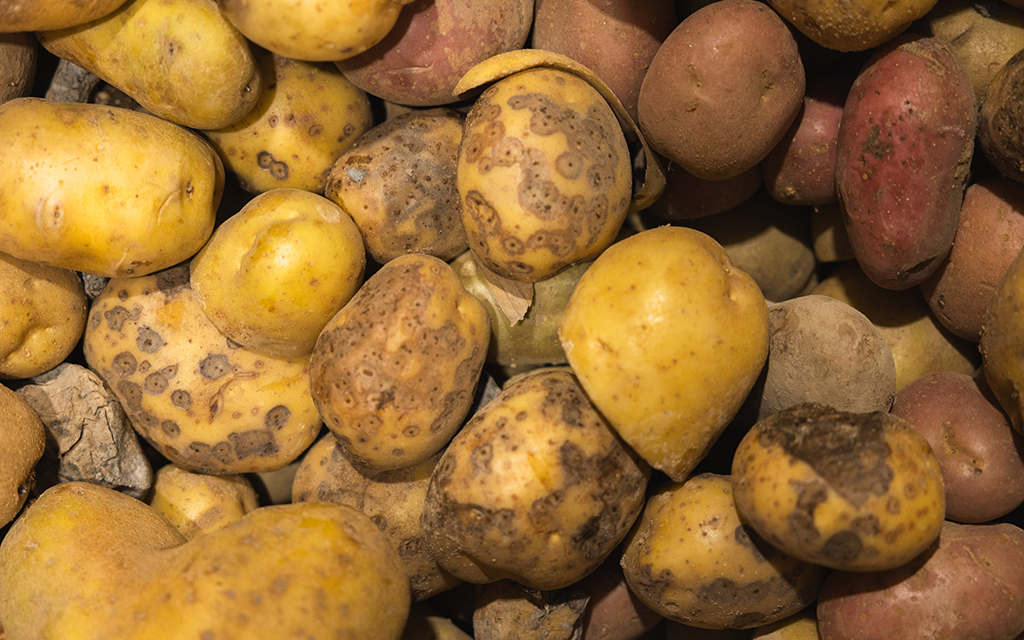
PataFEST brings together various European and Latin American partners around a shared goal: protecting the future of the potato against the main phytosanitary threats facing the crop. One of these partners is INIAP, Ecuador's National Institute of Agricultural Research, a country that brings something to the project Europe still doesn't have: direct experience with the disease known as "zebra chip," related to the potato purple top complex. Specialized in potato genetic improvement and in the study of the psyllid that transmits the zebra chip pathogen, INIAP's team leads the validation of bioassays against this disease within the project, work carried out at its own experimental stations.
That experience didn't come by chance. INIAP was invited to take part in this European Union call, and those extending the invitation wanted to know "what problems we had here in Latin America and specifically in Ecuador," recalls researcher Xavier Cuesta. Among the various topics discussed at that time, one ended up shaping INIAP's participation in the project: "the one that was most pressing for us at the time, and still is, was this purple top complex," a disease that, in his words, "could become, or in fact already is, a threat to European countries," with the risk that "this pest could eventually enter Europe and could be catastrophic if the necessary precautions aren't taken."
At that point, the team's main concern was clear. As Cuesta explains, "our biggest concern at the time was, first, having a way to efficiently diagnose the disease, both in field samples and by establishing an early diagnostic tool that would allow us, through images from some device, to identify the disease early and take action."
A natural laboratory Europe doesn't yet have
Cuesta explains what Ecuador's comparative advantage was at the time: "we were, at that moment, the only country here in Latin America that had the disease, well, here in South America that had the disease." That circumstance opened up a research possibility that didn't exist in Europe: "we could run different tests under controlled conditions or in the field, and see the response, especially of management alternatives, which couldn't be done in Europe."
That advantage rests on a concrete resource: a potato germplasm collection that, according to Cuesta, "is estimated at more than 500 accessions." From it, the team has been able to select materials to evaluate their response and look for possible sources of resistance. The work hasn't stopped at local germplasm: "germplasm was imported from Europe. Some varieties were chosen and are being tested," says Cuesta.
Carmen Castillo, also a researcher at INIAP, details how this evaluation has developed: "we've worked on those components, mainly evaluating the germplasm through bioassays against the vector," the insect Bactericera cockerelli, which according to Castillo "is what threatens the European continent, Asia too, and every place where potatoes are grown; it's a constant threat."
In addition to germplasm evaluation, INIAP has served as a testing site for natural products developed by other project partners. "Two companies sent us their products, and we evaluated them under controlled conditions," Cuesta relates, with results being reported to the project team to define next steps for field validation.
The challenge of diagnosing a disease that doesn't come alone
One of INIAP's contributions to the project has been building an image database of diseased plants. Castillo explains that the goal was "to take pictures of diseased plants to feed the database they needed," and although the target was to reach about 7,000 images, "I think we got to 3,000-something."
Behind that number lies an underlying difficulty running through the diagnostic work: "our constant concern was always that we have mixed infections," Castillo notes, which makes "it complicated to separate out the pathogens that are part of this complex that we... call the purple top complex."
To better understand that genetic complexity, INIAP collects insect and plant samples that it analyzes together with a partner in Poland. "One key point we haven't mentioned is that we collected insects and plant samples," Castillo says, material that, as she explains, Upol University in Poland is using for "genetic mapping, a genetic characterization of Liberibacter."
What's at stake for Ecuador
The figures the institute has on local impact are stark. According to Cuesta, "in terms of area (...) there's a documented 75% reduction in cultivated area compared to the years before the disease was identified," a decline accompanied by a sharp rise in chemical use: "the number of insecticide applications has increased between 50% and more than 100% in some areas."
For now, the country still produces what it consumes, but Cuesta warns that may not last: "so far we're self-sufficient in production (...) however, we know that if the trend continues in that direction, at some point we're going to have to import potatoes for consumption." Castillo adds another concern, tied to crop biodiversity: in a country where "500 native potato varieties have been identified," she suspects that, because of this disease, "germplasm has been lost in the field."
Beyond lab and experimental field research, Xavier Cuesta explains that the institute's underlying goal is "to develop integrated pest management technology with the aim, ultimately, of reducing pesticide use as much as possible, regardless of the pest." Before purple top, that work was already showing results with another disease, late blight, where "through the use of resistant varieties with integrated management, we managed to reduce pesticide use by up to 70% in some cases." But, as Cuesta acknowledges, "with the emergence of this new pest (...) we had to start over."
Among the measures already being applied, Cuesta mentions the introduction of "earlier-maturing varieties," which "are less likely to be affected than later-maturing varieties." Added to this is the evaluation of additional natural products beyond those the project contributes: "we've tested several options based on the use of natural products (...) we've identified at least two options that we know aren't sufficient on their own, but that, if integrated into a program (...) are alternatives."
Cuesta also notes that one of the biggest challenges at the start was informational: "what happened at the beginning was that the farmer didn't know about the new pest, and by the time they noticed, it was already too late." That's why, he says, "our efforts are currently focused on training farmers and technicians in early identification of the pest so they can take action." That work is already showing concrete progress in some areas, where "the farmer has learned to manage it (...) has established rotation strategies, has established zoning: where they can produce and in which other areas, they definitely won't be able to produce."
Part of that strategy has also meant looking to the knowledge farmers themselves already had. Cuesta explains that "we're precisely recovering that farmer knowledge, because farmers, in some cases, have for years used certain plants, for example, as insect repellents, and we, as technicians, hadn't in some cases evaluated them for this new pest." Now, he says, "we're testing the repellency of these plants (...) to see if there's scientific evidence proving they can be used, and how."
Reaching all farmers, however, isn't simple. Cuesta describes the context: "here, almost 90% of our farmers have operations of less than one hectare," and in many cases "don't have easy access to media or technology." The institute trains Ministry of Agriculture technicians directly, who then work with farmers in the field: "we provide the theoretical knowledge base (...) but the work in the real world falls to them, to the Ministry of Agriculture technicians."
That knowledge transfer also faces language barriers. Cuesta explains that "some communities still speak Quechua, or speak very little Spanish (...) and in some cases are also illiterate," which requires that "the design of communication materials has to be adapted to those specific conditions." That's why, he adds, "these materials have to be validated directly with farmers, to see if the message is getting through, whether the images and drawings are appropriate or not."
Cuesta also mentions an additional risk when the message doesn't reach all stakeholders uniformly: "some agrochemical shops or stores took advantage by giving farmers recommendations we knew were incorrect," something he attributes to the fact that "the message didn't reach all the technicians or the shops."
What Europe can still do differently
Drawing on Ecuador's experience, Castillo notes that Europe starts with a certain advantage: "Europe already has some countries, like Spain, with action plans in case the pest arrives." In South America, by contrast, preparedness was uneven: "few countries, like Chile, Brazil, and Argentina, are preparing; unfortunately, neither Ecuador, nor Colombia, nor Peru were prepared for this issue."
Castillo warns, however, that this time advantage has its limits: "the pest is very mobile (...) it's very dynamic and can break through any quarantine barrier," as happened even in countries with strict border controls: "it entered New Zealand and Australia, which have very strong quarantine barriers."
Closing out the interview, Castillo summed up the scale of the problem by citing a scientific article she often presents in her talks: "these plant diseases associated with bacteria and their vectors are increasing worldwide and causing very severe losses," compounded by an additional obstacle, "the scant and limited knowledge about these biological interactions between plants, insects, vectors, and pathogens (...) which makes it difficult to identify these problems and, of course, manage them."
Xavier Cuesta closed with a reflection on what's at stake for his region: "the potato crop originated here in the Andes and is at extremely high risk of being affected, reduced, or lost." That's why, he concludes, "we believe that with this project we will complement the actions that, as a region and as a country, we are undertaking."